- Artificial Intelligence
- Oct 1, 2026
- Insights
Moving from AI Proof of Concept to Secure, Production-Ready Enterprise AI
Your AI pilot delivered results. The model works. Users see potential. Leadership wants to know how quickly it can be rolled out.
That is where the harder part begins.
A successful AI pilot proves that a use case is possible. It does not necessarily prove that the business is ready to operate it across hundreds or thousands of users, connect it to sensitive enterprise data, govern its decisions, control its costs, and support it as part of everyday operations.
Before moving from pilot to production, leaders need to answer a different question:
Is the business ready to scale AI, not just build it?
TL;DR
- Pilot Success Is Only the Beginning: A proof of concept validates an idea. Production AI requires reliable data, scalable architecture, security, governance, integration, monitoring, and operational ownership.
- Data Readiness Determines AI Readiness: AI cannot consistently deliver trusted results when enterprise data is fragmented, inaccessible, poorly governed, or disconnected from business context.
- Security Must Be Built Into the Architecture: Identity, permissions, sensitive data controls, model access, and AI governance need to operate across every interaction, not be added after deployment.
- Scale the Business Outcome, Not the Demo: The real measure of AI success is not whether the model works, but whether it creates measurable business value reliably at production scale.
The AI Pilot Problem: Success Can Create a False Sense of Readiness
AI pilots are intentionally controlled. A small group of users tests a defined use case, data sources are limited, engineers closely monitor the system, exceptions can be handled manually, and infrastructure costs remain manageable.
Production removes those protections.
Instead of 20 users, the application may serve 2,000. Instead of querying one curated dataset, an AI assistant may need context from CRMs, ERPs, documents, operational databases, analytics platforms, APIs, and third-party systems. And instead of engineers watching every interaction, AI becomes part of normal business operations.
That transition changes the question from:
“Can the AI do this?”
to:
“Can our organization allow AI to do this securely, consistently, economically, and at scale?”
That is a much bigger challenge.
What Changes When AI Moves Into Production?
Scaling AI introduces dependencies that may barely appear during a pilot. An enterprise AI system must operate within the same business environment as every other production application, which means managing:
- Data: Is the information AI needs accurate, connected, current, and governed?
- Security: Can AI access only the information that the requesting user is authorized to see?
- Infrastructure: Can the architecture handle growing users, requests, models, integrations, and workloads?
- Integration: Can AI operate within existing applications and business workflows?
- Governance: Who determines what AI is allowed to access, recommend, generate, or execute?
- Operations: Who monitors quality, failures, costs, security events, and changing model behavior?
- Business Value: Can the organization demonstrate that AI is improving a meaningful operational or financial outcome?
A weakness in any one of these areas can prevent a technically successful pilot from becoming a sustainable production system.
From AI Pilot to Production AI Architecture
A scalable AI environment connects models with governed enterprise systems rather than treating AI as an isolated application.
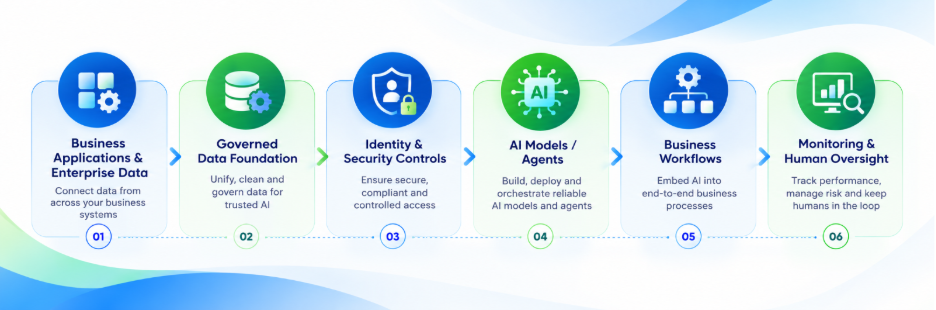
- Where does the AI obtain its information?
- What is it allowed to access?
- Which model should handle each task?
- What business systems can it interact with?
- What happens when confidence is low or something fails?
- How will performance and business impact be measured?
The objective is not simply to put an AI model into production. It is to create an environment in which AI can operate as a dependable part of the business.
7 Core Questions Before Scaling Your AI Pilot
1. Is Your Data Ready for Production AI?
Many AI pilots succeed because teams manually prepare the data needed for a specific experiment—an approach that does not scale. Production AI may need information spread across databases, documents, Microsoft 365 environments, CRM systems, ERP platforms, data lakes, APIs, and operational applications.
Technologies such as Microsoft Fabric can help consolidate data engineering, analytics, real-time intelligence, and business intelligence workloads into a unified environment. Governance and identity controls determine what applications, users, and AI agents are permitted to retrieve. The objective is simple: AI should receive the right business context without receiving data it should never see.
2. Can Your Security Model Scale With AI?
A pilot may operate using limited datasets and a small group of approved users. Production AI introduces a much larger security surface. Security therefore cannot depend solely on instructions given to the model. Production AI needs robust controls around:
- Identity and authentication
- Role-based access and data permissions
- Sensitive information and model/application access
- API/tool permissions, logging, auditing, and human approval for sensitive actions
For organizations operating in regulated environments, this is vital because AI adoption does not remove existing privacy, security, and compliance obligations.
3. Can Your Infrastructure Handle AI at Scale?
A successful demonstration says very little about production performance. Once adoption grows, organizations must account for larger request volumes, concurrent users, data retrieval, API traffic, model latency, storage, orchestration, monitoring, and compute consumption. Scaling must be treated as an architecture problem as much as an AI problem.
4. Is AI Connected to the Actual Business Workflow?
An AI pilot can be impressive without changing how work gets done. If employees have to leave their existing workflow, open a separate AI application, manually copy information, verify the output, and enter the result into another system, the organization has deployed AI without transforming the process. Production AI is far more valuable when embedded directly into workflows—such as service summaries inside customer support tools or account context inside a CRM.
5. Who Owns the AI After the Pilot Team Leaves?
During a pilot, responsibility is clear because the build team is monitoring it. Production requires ongoing operational ownership. Organizations need an AI operating model that defines responsibilities across technology, security, data, operations, and business teams for model performance, data quality, cost management, and incident response.
6. What Happens When the AI Is Wrong?
No production AI system should be designed around the assumption that every response will be correct. Organizations must determine which decisions AI can make independently, which require human review, and when the system should refuse to proceed. Human oversight should be designed directly into the production architecture.
7. Can You Measure the Business Value?
Pilot teams frequently measure technical performance; production leaders need to measure business performance (e.g., processing time, manual effort reduction, cost per transaction, employee productivity, customer response time, or error rates). Establishing a baseline before scaling is essential.
The AI Production Readiness Framework
Before scaling an AI pilot, leaders should be able to answer seven foundational questions:
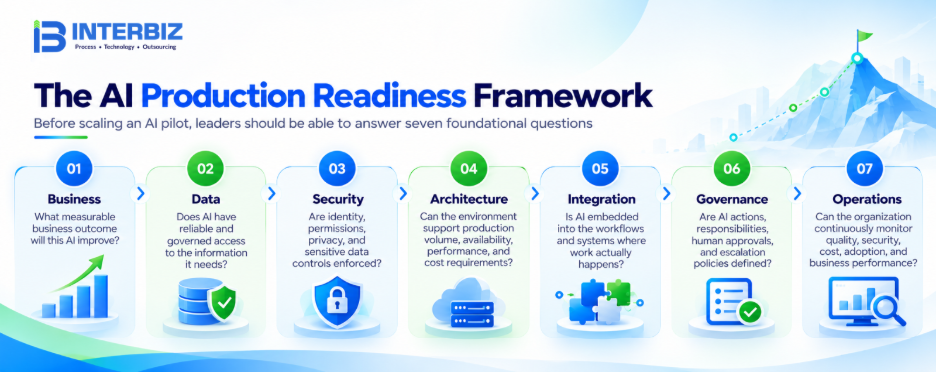
- Business: What measurable business outcome will this AI improve?
- Data: Does AI have reliable and governed access to the information it needs?
- Security: Are identity, permissions, privacy, and sensitive data controls enforced outside the model itself?
- Architecture: Can the environment support production volume, availability, performance, and cost requirements?
- Integration: Is AI embedded into the workflows and systems where work actually happens?
- Governance: Are AI actions, responsibilities, human approvals, and escalation policies clearly defined?
- Operations: Can the organization continuously monitor quality, security, cost, adoption, and business performance?
From One AI Use Case to an Enterprise AI Foundation
Most organizations will not stop with one AI use case. Building every initiative independently creates duplicated integrations, inconsistent security models, fragmented data access, and growing operational complexity.
A stronger approach is to use early successful initiatives to establish reusable enterprise capabilities:
- A governed enterprise data foundation
- Shared identity and access controls
- Reusable AI services, APIs, and integration patterns
- Centralized observability, monitoring, and governance policies
- Human approval frameworks, cost management, and reusable agent components
Microsoft Technologies for Scaling Enterprise AI
For organizations operating in the Microsoft ecosystem, production AI spans connected technology layers:
- Microsoft Azure: Provides cloud infrastructure, security, networking, and scalable computing.
- Azure AI Foundry & Azure OpenAI: Support enterprise AI applications, models, agents, and generative AI experiences.
- Microsoft Fabric & OneLake: Provide a unified data and analytics foundation for AI-driven workloads.
- Microsoft Purview: Supports broader data governance, classification, lineage, and information protection.
- Microsoft Entra ID: Provides identity and access controls across users, applications, and enterprise resources.
- Power Platform: Integrates AI capabilities into operational workflows rather than leaving them isolated in experimental silos.
Conclusion
Getting an AI pilot to work is an important milestone, but it answers only the first question. Scaling AI requires organizations to determine whether their data is ready, security controls are strong enough, infrastructure can support production demand, workflows are integrated, governance is defined, and business value can be measured.
The companies that move successfully from AI experimentation to enterprise adoption will not simply deploy more models. They will build the business and technology foundation that allows AI to operate securely, reliably, and repeatedly across the organization.
Ready to Move Your AI Pilot Into Production?
A promising AI proof of concept should not become another experiment that never reaches meaningful adoption.
InterBiz Consulting helps organizations connect AI strategy with data, cloud architecture, security, application engineering, integration, and operational workflows to build production-ready AI solutions. Whether you are preparing your first enterprise AI deployment, modernizing the data foundation behind an existing pilot, or building AI agents into business workflows, the focus remains the same: creating measurable business value from AI at scale.
Explore enterprise AI solutions
Frequently Asked Questions (FAQ)
Q1: What is the difference between an AI pilot and production AI? A: An AI pilot tests whether a particular use case, model, or workflow can deliver useful results in a controlled environment. Production AI must additionally support security, governance, reliability, integration, monitoring, scalability, cost management, and ongoing operational ownership.
Q2: Why do successful AI pilots fail to scale? A: The model itself is often only one part of the challenge. Scaling can expose problems involving fragmented data, security permissions, integration complexity, infrastructure capacity, operating costs, governance, user adoption, and unclear ownership.
Q3: How do you know whether an organization is ready to scale AI? A: Organizations should evaluate business value, data readiness, security, architecture, workflow integration, governance, operational ownership, monitoring, and human oversight before expanding an AI system into production.
Q4: Does an organization need a unified data platform before scaling AI? A: Not every AI application requires all enterprise data to be centralized. However, production AI does require reliable, governed, and appropriately permissioned access to the information necessary for its use case. A unified data architecture can make this easier to manage as the number of AI applications grows.
Q5: How should businesses measure AI ROI? A: AI performance should be connected to business metrics appropriate to the use case. These might include reduced processing time, lower manual effort, improved operational capacity, faster customer response, lower error rates, or increased employee productivity.