- Akash Pathak
- Oct 30, 2026
- Software Development
TL;DR: Key Takeaways
- Improved Application Reliability: Manage API traffic and reduce backend overload during peak demand.
- Stronger Data Security: Protect sensitive information through JWT validation, identity controls, and API access policies.
- Faster Application Performance: Optimize API responses and reduce unnecessary data transfer across applications.
- Simplified Multi-Client Integration: Connect web, mobile, and third-party applications through a centralized API gateway.
- Faster Partner Onboarding: Enable API discovery, documentation, and subscription management through a self-service Developer Portal.
- Better Operational Visibility: Monitor API traffic, response times, and failures to improve application reliability.
Introduction
When organizations discuss API management, conversations often focus on technical architecture, gateway configurations, authentication policies, and backend integrations. However, the real value of an API management strategy extends beyond infrastructure. Consider a customer trying to complete an online payment, a patient accessing healthcare information, or a business partner connecting an application to an enterprise platform. Each interaction depends on APIs communicating reliably with backend systems. A slow response, failed request, unauthorized access, or incompatible data format can interrupt the entire experience. This is where Azure API Management (APIM) becomes important. By acting as a centralized gateway between applications and backend services, APIM helps organizations manage API traffic, enforce security controls, standardize data exchange, and improve integration efficiency. Instead of treating API management as a backend technical requirement, enterprises can use it as an important part of their digital experience strategy. Let's explore how Azure API Management delivers value across application performance, security, reliability, and enterprise integration.1. Improved Application Reliability: Keeping Digital Services Available
Application availability directly influences customer satisfaction and business continuity. Imagine an e-commerce platform experiencing a sudden increase in traffic during a major promotional event. Hundreds or thousands of users may simultaneously search for products, check availability, and complete purchases. Without appropriate traffic management, excessive API requests can place significant pressure on backend services, affecting application responsiveness and availability. Azure API Management helps manage these situations through configurable traffic control policies.- Rate limiting: Controls how frequently individual clients can access APIs, helping prevent excessive requests.
- Usage quotas: Establishes consumption limits over defined periods, supporting predictable API usage.
- Traffic management: Applies policies to control incoming requests and protect backend capacity.
- Retry policies: Can retry eligible backend requests when configured conditions are met, helping handle certain temporary failures.
2. Stronger Data Security: Protecting User Information and Business Systems
Security is one of the most important considerations when applications exchange sensitive information. Healthcare platforms handle patient information, financial applications process transaction data, and enterprise systems manage confidential business records. Exposing backend services without appropriate access controls can increase the risk of unauthorized access and data exposure. Azure API Management provides gateway-level security capabilities that help organizations establish consistent API access controls.- JWT validation: Validates authentication tokens before requests are forwarded to backend services.
- IP filtering: Restricts API access based on configured IP address rules.
- Subscription management: Controls API consumption through subscription credentials.
- Header and payload transformation: Removes or modifies selected information before responses reach external applications.
- Identity integration: Supports integration with Microsoft Entra ID and other identity providers through appropriate configurations.
3. Faster Application Experiences Through Optimized API Responses
Users expect applications to respond quickly, whether they are accessing a desktop portal, mobile application, or third-party service. One common challenge is unnecessary data transfer. Backend systems may return large response payloads containing information that a particular application does not need. This can increase network usage, affect response times, and create additional processing requirements for client applications. Azure API Management can help address this through request and response transformation policies.- Payload transformation: Converts supported response formats into structures expected by client applications.
- Header management: Adds, removes, or modifies HTTP headers based on application requirements.
- Response filtering: Removes selected fields that are not required by the requesting application.
- URL rewriting: Routes requests to the appropriate backend endpoints without exposing internal endpoint structures.
4. Simplified Multi-Client Integration: One Gateway, Multiple Applications
Enterprise environments often include multiple applications that need to access the same backend services. A healthcare platform might connect patient portals, provider applications, administrative systems, and external healthcare partners. Each application may have different integration requirements. Without centralized API management, maintaining separate integration logic for every client can increase development and maintenance complexity. Azure API Management provides a common API gateway through which multiple applications can access shared backend services.- Establishes consistent API endpoints for different applications.
- Applies common authentication and access policies.
- Supports request and response transformations.
- Simplifies API versioning and lifecycle management.
- Reduces the need for duplicated gateway-level integration logic.
5. Faster Partner Onboarding Through a Self-Service Developer Portal
For enterprises offering APIs to external partners, onboarding can become a time-consuming process. Integration teams may need to exchange documentation, configure access credentials, explain API endpoints, and coordinate testing before a partner can connect successfully. Azure API Management simplifies this process through its Developer Portal. The Developer Portal provides a centralized location where authorized developers can discover APIs, review documentation, understand access requirements, and test available endpoints.- Self-service API discovery: Developers can explore published APIs and understand available integration options.
- Subscription management: Authorized users can request or manage API subscriptions according to configured approval and access rules.
- Interactive API documentation: Developers can review API specifications and test supported operations through the portal.
- Product-based API access: Organizations can group APIs into products with different subscription and access requirements.
6. Better Operational Visibility: Understanding API Performance
A reliable application requires more than successful API connections. Engineering teams also need to understand how those connections perform. Without adequate monitoring, organizations may struggle to identify recurring failures, slow backend responses, excessive traffic, or integration issues. Azure API Management supports operational visibility through its monitoring and diagnostic capabilities. When integrated with Azure Monitor and Application Insights, teams can analyze relevant API telemetry and investigate application behavior.- API request volume: Understand how frequently individual APIs are accessed.
- Response latency: Identify endpoints experiencing slower responses.
- Error rates: Investigate failed requests and recurring API errors.
- Traffic patterns: Understand usage trends across applications and API consumers.
- Backend performance: Identify whether delays originate at the gateway or backend service.
How Azure API Management Features Translate Into Business Value
Azure API Management connects technical capabilities with measurable operational and user experience benefits.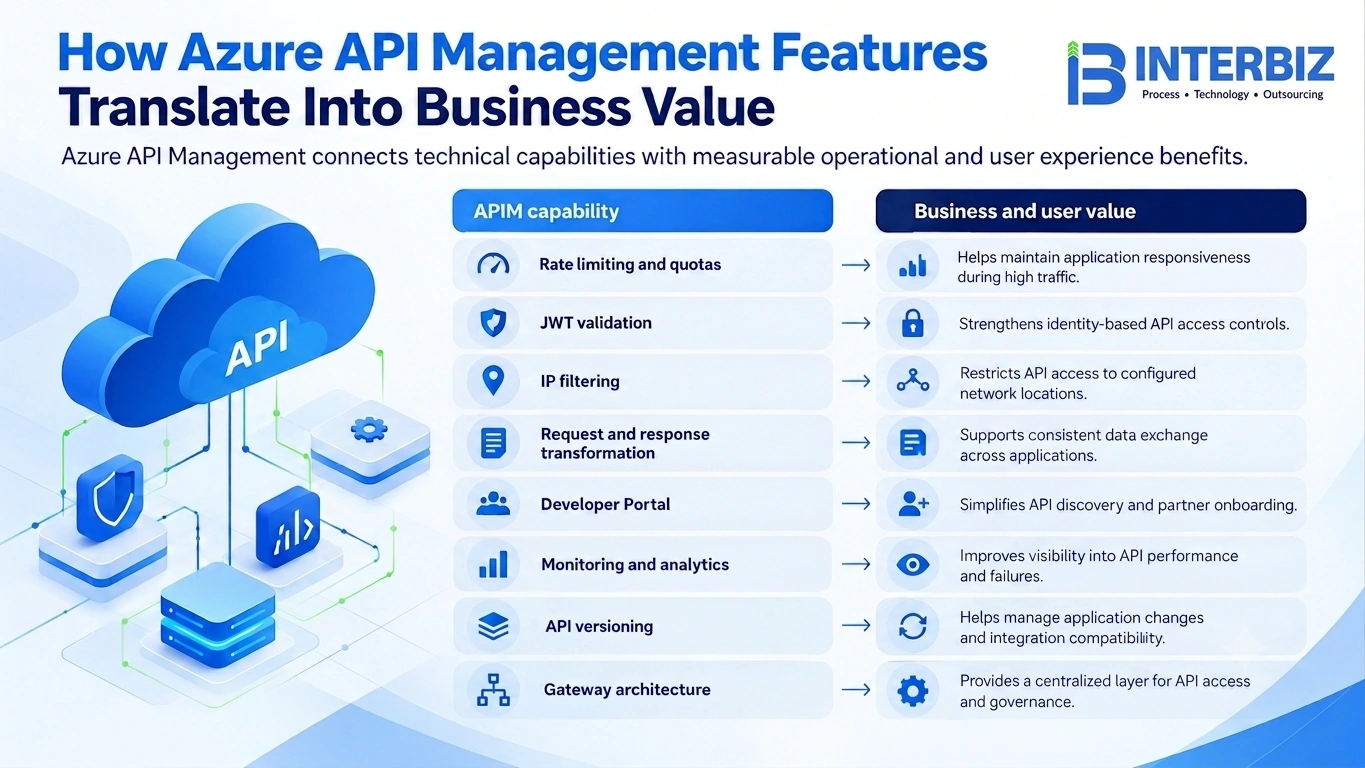
Conclusion: Turning API Management Into a Better Digital Experience
Azure API Management is more than an API gateway. It is an important part of an enterprise integration strategy that connects application performance, security, reliability, and partner collaboration. By managing API access centrally, applying appropriate security policies, controlling traffic, and standardizing data exchange, organizations can create more consistent digital experiences across applications and services. For businesses operating in healthcare, financial services, retail, and other data-intensive industries, these capabilities can help support secure integrations and more reliable application experiences. The objective is not simply to manage more APIs. It is to ensure that every application, user, and authorized partner can interact with enterprise systems securely and efficiently.Frequently Asked Questions About Azure API Management Benefits
1. What are the main benefits of Azure API Management?
The main benefits include centralized API governance, improved access security, traffic management, API monitoring, request and response transformation, and simplified integration with external applications and partners.2. How does Azure API Management improve application performance?
APIM helps manage API traffic through rate limiting and quotas. It can also transform request and response payloads, manage headers, and route requests to appropriate backend services. These capabilities can improve resource utilization and application responsiveness when properly configured.3. How does Azure API Management support API security?
Azure API Management supports JWT validation, subscription management, IP filtering, identity integration, and configurable security policies. These controls help manage API access and should be combined with backend security and appropriate network protections.4. What is the role of the Developer Portal in Azure API Management?
The Developer Portal allows developers and authorized partners to discover APIs, review documentation, test available operations, and manage subscriptions. It helps standardize API onboarding and reduce manual coordination.5. Can Azure API Management support multiple applications?
Yes. APIM can expose common backend services through managed API endpoints for different consumers, including web applications, mobile applications, internal systems, and external partners. Policies can help accommodate different access and data requirements.6. Does Azure API Management improve API reliability?
APIM provides traffic management, rate limiting, quotas, monitoring, and configurable retry policies. These capabilities help manage traffic and handle certain temporary failures. Overall application reliability also depends on backend availability, infrastructure design, and appropriate recovery mechanisms.7. How does Azure API Management help protect sensitive data?
APIM can validate access tokens, restrict configured IP addresses, and transform API responses to remove selected information. Organizations should also implement appropriate encryption, backend authorization, data protection, and logging controls.8. Can Azure API Management reduce partner integration time?
Yes. Its Developer Portal, API documentation, subscription management, and API products can simplify partner onboarding. The actual time savings depend on API readiness, partner requirements, approval processes, and integration complexity.9. Is Azure API Management suitable for healthcare applications?
Yes. APIM can support healthcare application integrations by providing centralized API access, authentication policies, traffic controls, and monitoring. However, healthcare organizations must also implement appropriate privacy, security, regulatory, and data governance controls.10. How does Azure API Management support digital transformation?
APIM helps organizations connect applications, modernize integrations, standardize API access, and manage communication between cloud and legacy systems. These capabilities support more connected digital services and evolving enterprise application architectures.Explore RoviCare: Azure-Powered Healthcare Integration
Healthcare applications require secure communication between multiple systems, providers, and digital platforms. RoviCare demonstrates how Microsoft Azure technologies can support a connected healthcare referral and care coordination platform. Know More About RoviCare Explore the RoviCare Case Study to learn more about Interbiz Consulting's healthcare technology implementation and Azure-based solutions. Interested in improving your enterprise API architecture? Connect with Interbiz Consulting to discuss your Azure integration, API management, and application modernization requirements. Contact us