- Data & Analytics
- Oct 5, 2026
- Insights
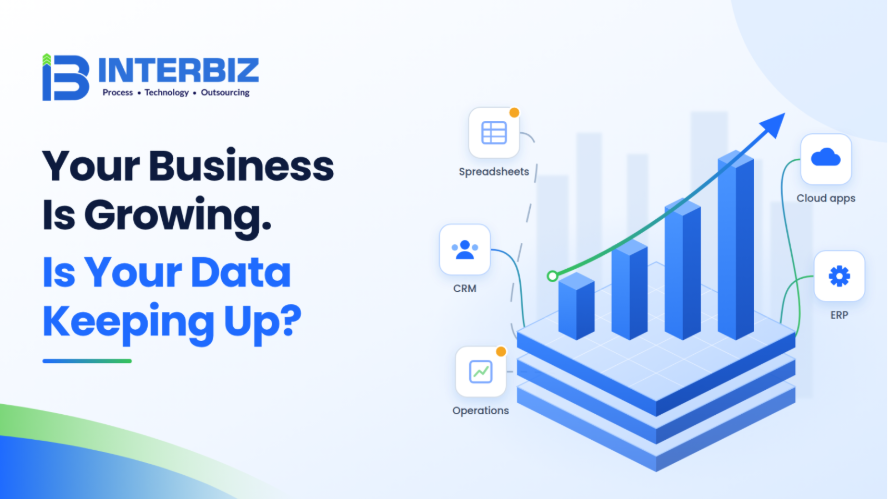
Disconnected systems and inconsistent data slow decisions and raise risk. See how clear ownership and stronger governance support trust, growth, and AI readiness.
Scale is the ultimate validator for any high-growth enterprise. Rising revenue, an expanding customer base, and multiplying operational workflows are clear signals of market traction. Yet, for many fast-growing organizations, rapid expansion frequently exposes a critical, hidden vulnerability: an underlying data architecture that simply cannot keep pace with the business.
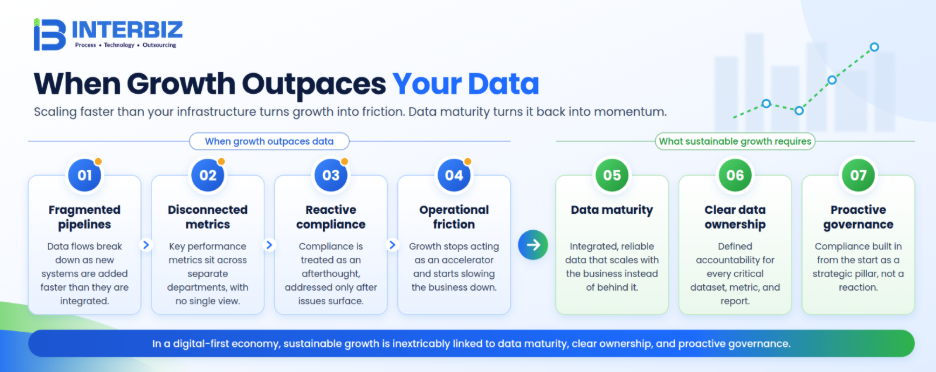
When a company scales faster than its infrastructure, data pipelines become fragmented. Key performance metrics end up siloed across disconnected departments, and data compliance is often treated as a reactive afterthought rather than a strategic pillar. At this tipping point, growth stops acting as a natural accelerator and instead begins generating immense operational friction. In today's digital-first economy, sustainable enterprise growth is inextricably linked to data maturity, clear data ownership, and proactive governance.
TL;DR
- The Core Problem: Rapid business growth often outpaces underlying data architectures, resulting in fragmented data silos, delayed decisions, and rising risks.
- The Stakeholder Shift: Modern enterprise purchasing decisions involve 6 to 13 cross-departmental stakeholders, with data governance and AI readiness moving to the top of the executive agenda.
- The Solution: Transitioning from reactive data patches to proactive governance through clear domain ownership, audit readiness, and clean data pipelines.
- The Business Impact: Unlocks faster decision-making, uncompromised customer trust, and a scalable foundation for advanced AI integration.
The Hidden Cost of Disconnected Systems
In the early stages of a company's lifecycle, moving fast and breaking things is a celebrated mantra. Teams adopt point solutions, build quick integrations, and rely on manual data exports to make decisions. But as the organization matures, this patchwork approach transforms into a tangled web of disconnected systems.
When data is inconsistent across platforms, the impact is felt across the entire organization:
- Slower Decision-Making: When marketing, sales, and finance departments pull reports from different systems and arrive at conflicting revenue or engagement numbers, leadership is forced to pause. Instead of making agile, data-driven decisions, executives spend valuable time arguing over whose dashboard is accurate.
- Elevated Organizational Risk: Fragmented data creates massive blind spots in security and compliance. Without a unified view of where sensitive customer data lives, who has access to it, and how it is used, organizations are left highly vulnerable to regulatory audits, data breaches, and a fundamental loss of consumer trust.
- Eroding Customer Trust: Customers expect a seamless, unified experience. When customer service representatives lack access to real-time order histories stored in a separate logistics database, the resulting friction damages the brand's reputation and drives churn.
The Evolving Anatomy of Enterprise Decision-Making
To understand why data maturity has moved to the very top of the executive agenda, we must look at how enterprise decision-making has fundamentally changed. The days of a single department operating its technology stack in isolation are completely gone.
According to Forrester research, the average B2B purchase now involves roughly 13 stakeholders, with 89% of decisions crossing multiple departments. Furthermore, Gartner notes that complex-solution buying groups typically range from 6 to 10 people, with 74% of these teams reporting internal conflict and competing organizational priorities.
Because data flows across every departmental boundary, fixing data fragmentation requires enterprise-wide consensus. Buying and steering committees now routinely include compliance, risk, legal, and data-governance leaders who hold direct budget authority and explicit veto power. The strategic importance of the Chief Data Officer (CDO) has skyrocketed, with CDOs now present in roughly 74% to 84% of large organizations.
With approximately 70% of data and analytics leaders now owning their organization's AI strategy and operating model, fixing fragmented data is no longer just an administrative task for software engineers. It is an immediate, board-level prerequisite for deploying real-time visibility, automated workflows, and trusted AI solutions.
Moving from Reactive Patchwork to Strategic Governance
Overcoming these systemic challenges requires a fundamental shift in organizational mindset. Companies must stop treating data governance as a bureaucratic barrier or a compliance checkbox. Instead, they must start viewing it as a core strategic pillar that enables safe, rapid scaling.
Transitioning to a mature data posture involves three critical steps:
1. Establish Clear Data Ownership
Data cannot govern itself. Assigning explicit data owners and data stewards at the domain level ensures absolute accountability. When every dataset—from customer demographics to supply chain logistics—has a clear owner, organizations can confidently establish single sources of truth. This eliminates conflicting cross-departmental metrics and ensures that data quality is actively monitored and maintained.
2. Strengthen Governance and Audit Readiness
Strong governance replaces ad-hoc data handling with standardized policies for data collection, classification, and access control. By aligning data architecture with global privacy and security frameworks from day one, organizations ensure seamless navigation of periodic assessments and audits. When governance is built-in rather than bolted on later, scaling into new markets or launching new products becomes exponentially faster and safer.
3. Prioritize AI Readiness
Artificial intelligence is transforming the enterprise, but advanced analytics, predictive machine learning models, and autonomous agentic workflows absolutely cannot function on polluted or siloed data. If you feed an AI system inconsistent or biased data, it will generate confident but entirely incorrect outputs. True AI readiness begins with pristine, well-governed data pipelines. Clear data lineage and metadata management are the bedrock upon which reliable, enterprise-grade AI is built.
Partnering for Secure, Scalable Growth
Navigating the complex intersection of rapid business scale, rigorous security requirements, and advanced data architecture requires specialized, battle-tested expertise. At Interbiz Consulting, we partner with ambitious, high-growth organizations to bridge the widening gap between scaling operations and maintaining robust data governance.
We help enterprises replace disconnected legacy systems with modernized, resilient architectures. Our teams work alongside your leadership to design comprehensive data strategies that institute clear ownership, enforce rigorous quality standards, and eliminate the silos that slow down your workflows. By aligning your technology stack with your long-term business goals, we ensure that your platform remains agile, audit-ready, and fully primed to leverage the next generation of AI and machine learning tools.
Conclusion
Enterprise growth should never come at the expense of data integrity, operational security, or internal agility. When your data architecture lags behind your business momentum, the resulting friction raises your risk profile and stifles innovation.
By replacing disconnected, legacy systems with robust data governance, crystal-clear ownership, and a resilient, scalable architecture, forward-thinking enterprises can insulate themselves against rising regulatory pressures. More importantly, they lay an unshakeable foundation for long-term innovation, uncompromised customer trust, and true AI readiness.
Data is the lifeblood of your growing enterprise. Ensure it flows cleanly, securely, and with purpose.
Frequently Asked Questions (FAQ)
Q1: What are the primary warning signs that our enterprise data architecture is failing to keep up with growth?
A: Common indicators include departments working from conflicting reports (e.g., sales and finance reporting different revenue figures), prolonged onboarding or reporting cycles due to manual data consolidation, recurring bottlenecks during security and compliance audits, and difficulty deploying reliable AI or automation initiatives because of messy underlying data.
Q2: Why is robust data governance critical for successful AI implementation?
A: AI models rely entirely on the quality of the data fed into them. Without structured governance, data lineage tracking, and cleanliness standards, machine learning models and LLMs will generate inaccurate outputs, hallucinations, or compliance violations. Governance ensures that your AI systems operate on trusted, high-context data.
Q3: How does establishing clear data ownership improve cross-functional alignment?
A: When specific individuals or teams are assigned formal ownership of distinct data domains, ambiguity disappears. Everyone in the organization knows exactly who is accountable for data definitions, quality checks, and access permissions, eliminating internal friction and speeding up executive decision-making.
Ready to Scale Without Compromise?
Is your data infrastructure equipped to support your next major phase of growth? Partner with experts who understand the deep technical nuances of enterprise scaling and data strategy.
Visit the InterBiz Consulting website to discover how we help industry leaders build, scale, and secure their digital platforms.