- Cloud Engineering
- Oct 7, 2026
- Insights
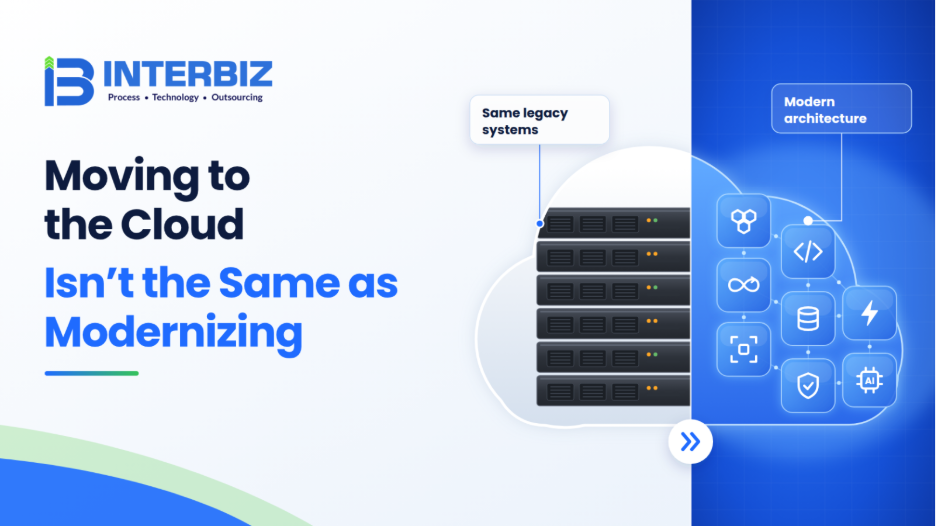
Migration changes where applications run; modernization changes what they deliver. See the questions that turn cloud spend into agility and operational value.
For the past decade, enterprise IT strategy has been dominated by a singular directive: "Get to the cloud." Boardrooms, executives, and technology leaders have treated cloud migration as the ultimate finish line of digital transformation. Companies packed up their on-premise virtual machines, executed "lift-and-shift" migrations to AWS, Azure, or Google Cloud, and declared success.
Yet, many organizations soon discover an uncomfortable reality. Their infrastructure bills have skyrocketed, but their release cycles remain painfully slow. Their applications still suffer from monolithic bottlenecks, and developers spend more time managing brittle infrastructure than shipping new features.
The disconnect lies in a fundamental misunderstanding: moving to the cloud is not the same as modernizing. Migration changes the address of your applications; modernization changes how they live, breathe, and deliver value.
TL;DR
- The Core Distinction: Migration is simply changing where applications run (moving from on-premise servers to cloud hosting), whereas modernization changes what they deliver (agility, scalability, and speed).
- The Lift-and-Shift Trap: Simply re-hosting legacy monolithic applications in the cloud often drives up operational costs without solving architectural bottlenecks or developer friction.
- The Strategic Shift: True modernization involves adopting cloud-native architectures, containerization, microservices, and automated pipelines to unlock real business value.
- The Bottom Line: Moving to the cloud is just the starting line; modernization is how enterprises turn cloud infrastructure spend into measurable agility and competitive advantage.
The Illusion of Migration (The Lift-and-Shift Trap)
When under pressure to modernize quickly, organizations often default to a lift-and-shift migration strategy. They take existing, legacy applications—built years ago for static, on-premise servers—and re-host them virtually in a cloud environment with minimal architectural changes.
While this approach gets workloads out of physical data centers quickly, it carries hidden pitfalls:
- Amplified Inefficiencies: Running an unoptimized, tightly coupled monolithic application in the cloud doesn't make it efficient; it just makes it more expensive. You are now paying cloud providers premium rates to run legacy code that cannot autoscale or leverage cloud-native services.
- Persistent Maintenance Overhead: The underlying codebase remains fragile. Technical debt is untouched, meaning your engineering teams remain bogged down patching bugs and managing infrastructure rather than innovating.
- The Cost-to-Value Disconnect: Leadership expects cloud adoption to instantly unlock agility and cost savings. Instead, they see cloud budgets ballooning without a corresponding increase in delivery velocity or operational performance.
Cloud migration is a necessary logistical step, but treating it as the destination rather than the starting point leaves massive competitive advantage on the table.
What True Cloud Modernization Looks Like
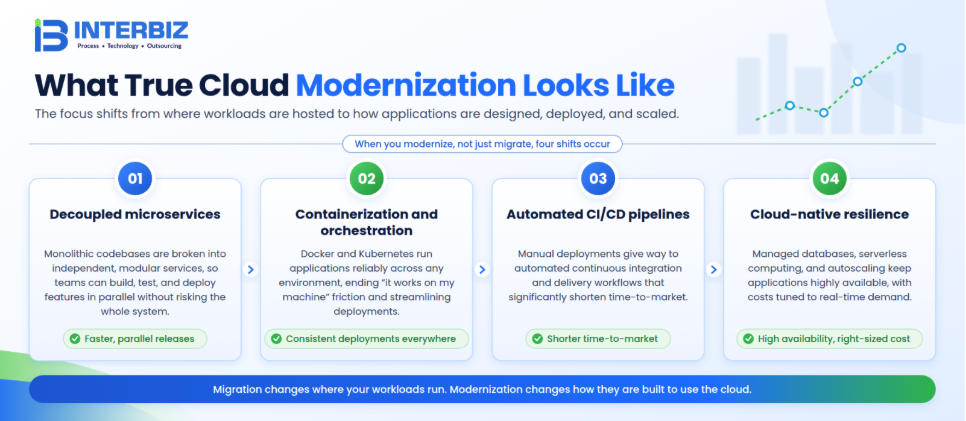
True modernization is an architectural evolution. It shifts the focus from where workloads are hosted to how applications are designed, deployed, and scaled. Modernized systems are built to exploit the native capabilities of the cloud.
When an enterprise commits to modernization rather than mere migration, several transformative shifts occur:
- Decoupled Microservices: Monolithic codebases are broken down into independent, modular services. This allows different teams to develop, test, and deploy features concurrently without risking the stability of the entire system.
- Containerization and Orchestration: Technologies like Docker and Kubernetes ensure that applications run reliably across any environment, eliminating "it works on my machine" friction and streamlining deployments.
- Automated CI/CD Pipelines: Manual deployments are replaced by robust, automated continuous integration and continuous delivery workflows, drastically cutting down time-to-market.
- Cloud-Native Resilience: Modern applications leverage managed databases, serverless computing, and automated autoscaling, ensuring high availability and cost efficiency tuned precisely to real-time demand
Key Questions to Turn Cloud Spend into Agility
To bridge the gap between running in the cloud and truly modernizing, technology leaders must continuously evaluate their architecture with rigorous, outcome-driven questions:
- Are we refactoring, or just re-hosting? If your applications are architected exactly the same way they were five years ago, you haven't modernized—you've just changed landlords.
- Does our cloud architecture enable developer velocity? How long does it take your engineering team to push a new feature from code commit to production? If the answer is weeks instead of hours, your cloud setup isn't delivering agility.
- Are we leveraging cloud-native managed services? Are you utilizing built-in cloud capabilities for security, scaling, and data processing, or are you manually managing infrastructure tools that cloud providers have already automated?
- Is our cloud spend tied directly to business value? Can you trace your cloud infrastructure costs directly to revenue-generating features and customer experiences, or is budget leaking into idle, over-provisioned resources?
Conclusion
Migrating to the cloud is a critical milestone in an enterprise's digital journey, but it is only the foundation. Stopping at migration leaves your organization vulnerable to high costs, architectural debt, and sluggish innovation.
True transformation happens when you move beyond where your applications live and focus entirely on what they deliver. By embracing cloud modernization—rearchitecting for agility, automating workflows, and leveraging cloud-native principles—you transform infrastructure spend from a burdensome operational cost into your greatest competitive advantage.
Frequently Asked Questions (FAQ)
Q1: What is the main difference between cloud migration and cloud modernization?
A: Cloud migration (often called lift-and-shift) simply moves existing applications from physical data centers to cloud infrastructure without changing their code or architecture. Cloud modernization involves refactoring and updating those applications to take full advantage of cloud-native capabilities, such as microservices, scalability, and automated pipelines.
Q2: Why do many "lift-and-shift" cloud migrations fail to deliver expected cost savings?
A: Monolithic legacy applications are rarely optimized for cloud environments. Running inefficient, tightly coupled code in the cloud often leads to over-provisioning and high infrastructure bills without improving system performance or reducing maintenance overhead.
Q3: How do I know if my enterprise is ready to start modernizing its applications?
A: Key indicators include slow deployment cycles, high frequency of deployment errors, scaling difficulties during peak traffic, and engineering teams spending more time managing infrastructure and patching legacy code than building new customer-facing features.
Ready to Turn Cloud Spend into Agility?
Are your cloud investments actually accelerating your business, or are you just running legacy systems in a new environment? Partner with engineering experts who know how to unlock the true potential of cloud architecture.