- Artificial Intelligence
- Oct 10, 2026
- Insights
The most transformative AI initiatives rarely begin with a disruptive new tool. They begin with everyday operational friction.
Across modern enterprises, the rush to deploy artificial intelligence has led many executive teams into a common trap: acquiring sophisticated technology first, then searching for a problem to solve. This technology-first approach frequently results in disjointed pilot projects, low team adoption, and unclear returns on investment.
True digital maturity requires a strategic shift. The most effective entry point for AI automation lies within your existing operational infrastructure—specifically where highly skilled teams are constrained by repetitive, manual execution. By targeting high-friction bottlenecks rather than technological novelty, forward-thinking organizations implement intelligent automation that reduces manual labor while keeping strategic control firmly in human hands.
TL;DR
- Focus on Friction, Not Tools: Successful AI adoption begins by identifying daily operational bottlenecks, not buying shiny new software.
- Target High-Impact Workflows: Prioritize repetitive tasks like swivel-chair data entry, document processing, and routine approvals for quick wins and high ROI.
- Evaluate Enterprise Readiness: Assess data governance, process standardization, security guardrails, and team readiness before deploying capital.
- Deploy Production-Grade AI: Move beyond generic pilots by integrating tailored models into native enterprise systems (like Microsoft Azure) with strict human-in-the-loop oversight.
1. Spotting Operational Friction Points
Every growing enterprise accumulates operational debt as it scales. As software ecosystems expand, employees often bridge platform gaps through manual labor. Identifying the ideal starting point for AI automation requires auditing daily workflows across three primary friction models:
- Swivel-Chair Workflows: Highly paid talent spending critical hours transferring information between legacy ERPs, CRM platforms, and internal communications.
- Unstructured Data Bottlenecks: Skilled staff manually reading incoming PDF invoices, vendor contracts, or support logs to extract key variables.
- High-Volume Routine Decisions: Categorizations, data validations, and approvals that rely on structured logic rather than nuanced strategic evaluation.
When evaluating operational readiness, refrain from asking, "Where can we implement AI?" Instead, evaluate: "Where are our teams functioning as human data conduits?" Targeting these friction points yields immediate efficiency gains and establishes measurable ROI benchmarks from day one.
2. Executive Readiness: Is Your Organization Prepared for AI?
Before committing capital to automation deployment, executive leadership must evaluate organizational readiness across key operational dimensions. Technology alone does not guarantee performance; architectural and operational preparedness dictate outcomes.
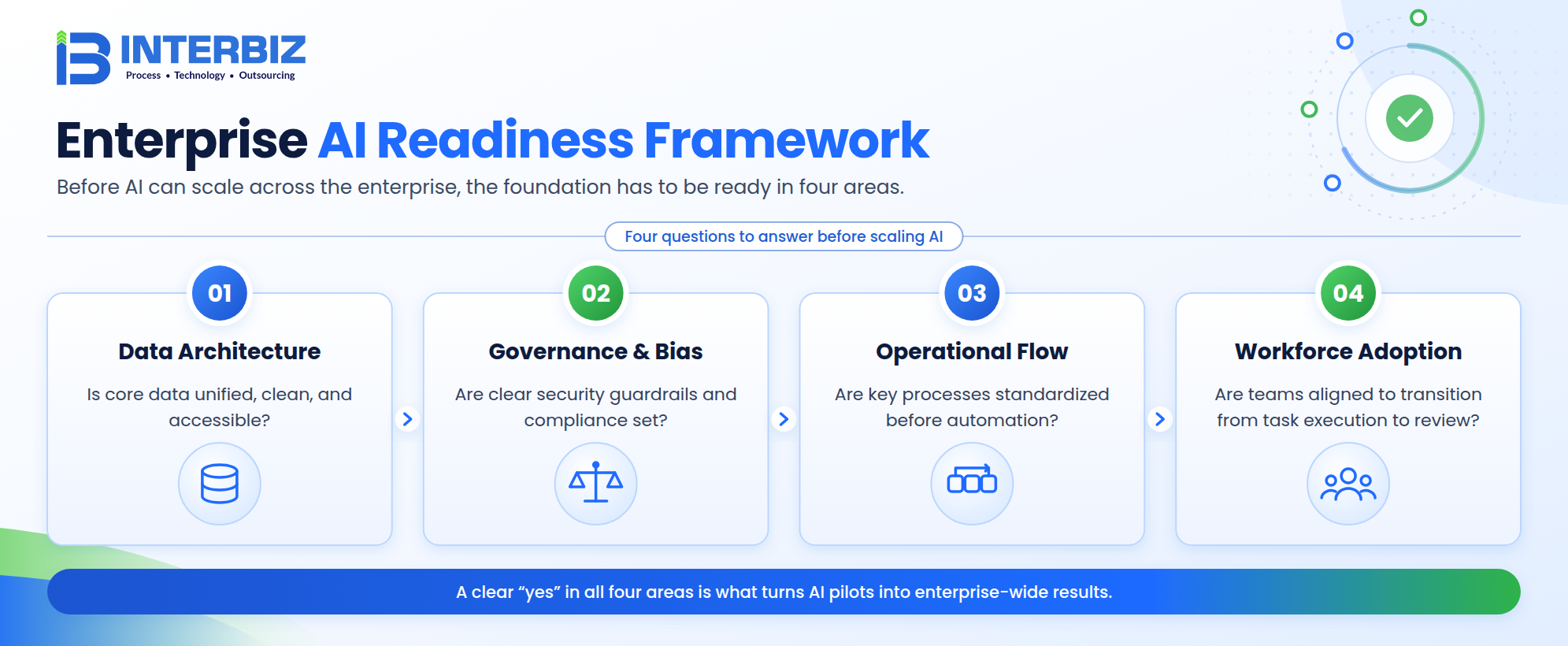
Key Readiness Indicators:
- Data Governance & Accessibility: Is enterprise data centralized, structured, and secure, or locked in disparate operational silos?
- Process Standardization: Are workflows clearly documented and standardized before automation, avoiding the digitization of flawed logic?
- Security & Guardrails: Are security frameworks established to prevent data leakage and protect proprietary IP?
- Cultural & Operational Alignment: Is leadership prepared to transition team focus from manual execution to oversight and high-value strategy?
3. Strategic Evaluation: High Impact vs. Low Complexity
Not every operational challenge requires artificial intelligence, and not every deployment delivers equal value. To maximize capital efficiency and minimize risk, leadership must evaluate potential use cases through a dual matrix of business impact and implementation complexity:
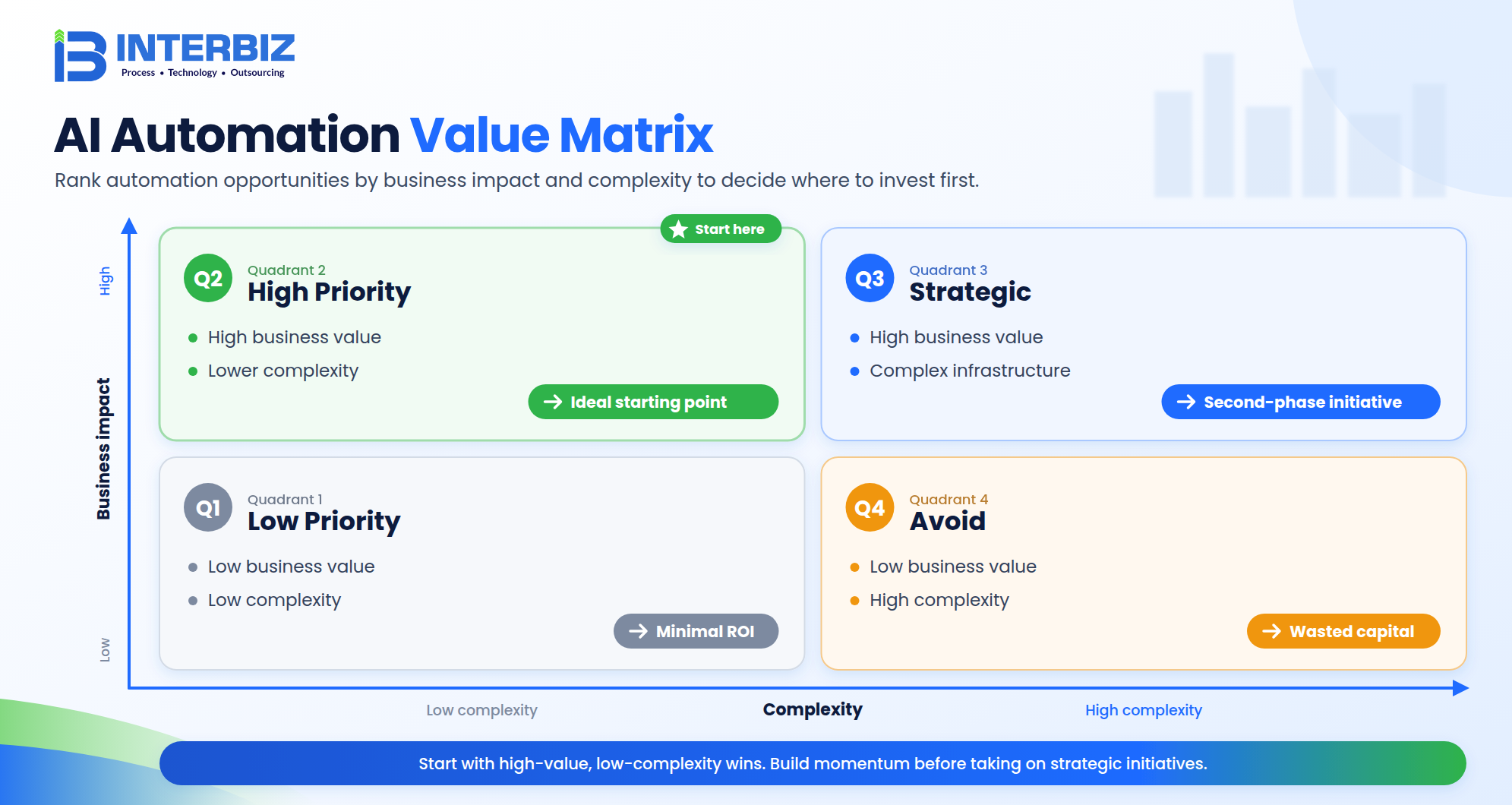
By categorizing processes within this matrix, executive teams establish a pragmatic sequence: target low-complexity, high-impact workflows first to build institutional momentum and demonstrate quantifiable savings before undertaking broad enterprise-wide transformations.
4. Moving From AI Experimentation to Production-Ready Execution
Transitioning from isolated pilots to enterprise automation requires an engineering-first architecture rather than ad-hoc tools. Moving to production-ready systems demands a disciplined, four-stage execution roadmap:
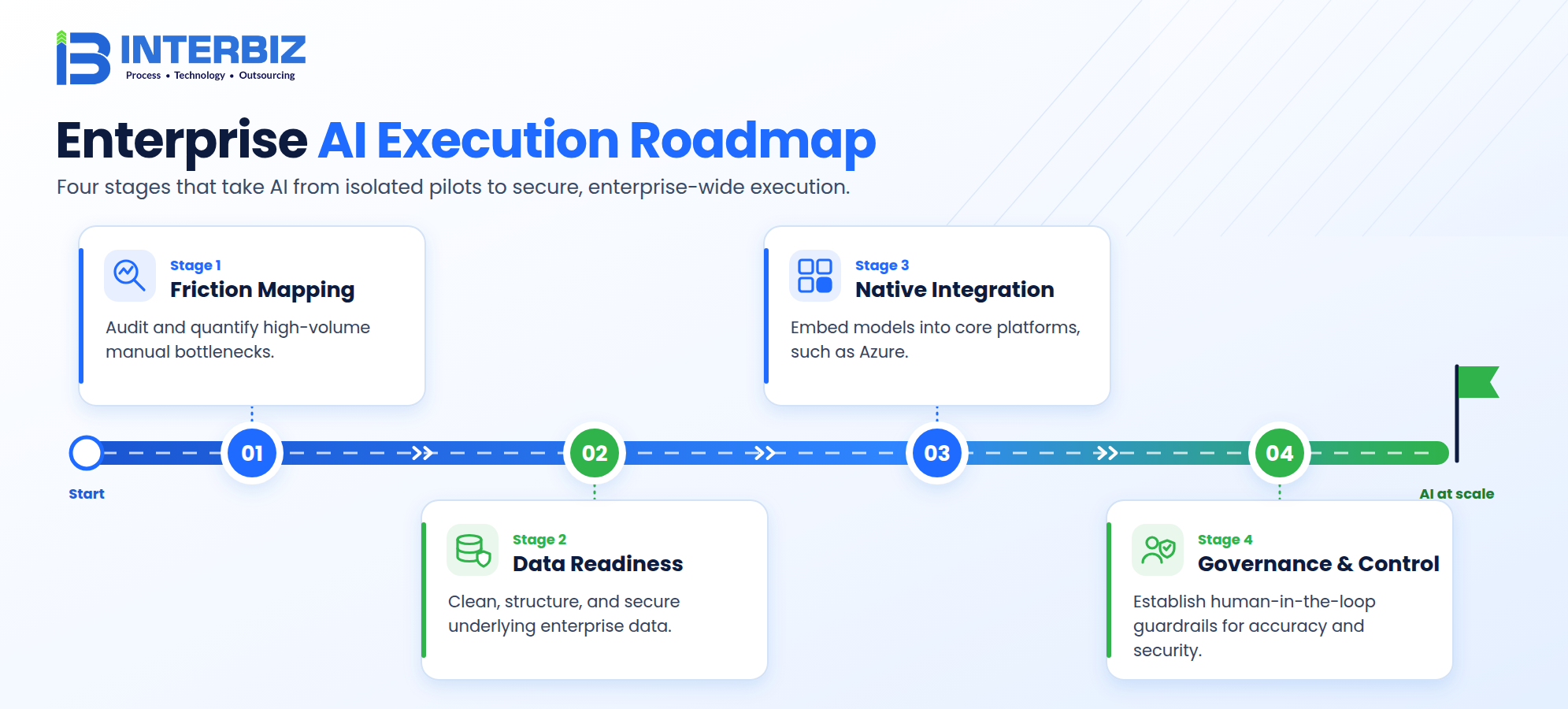
- Friction Mapping: Audit operational workflows to quantify manual hours, error rates, and data velocity across department lines.
- Data Readiness & Architecture: Organize, clean, and secure underlying enterprise data to feed models reliably without compromise.
- Native Enterprise Integration: Embed intelligent models directly into core operating environments—such as Microsoft Azure, cloud data infrastructure, and custom platforms—eliminating context-switching.
- Governance & Oversight: Implement robust human-in-the-loop guardrails. Automated logic handles synthesis, classification, and drafting, while domain experts retain final approval authority over output quality and compliance.
Frequently Asked Questions (FAQs)
What is the ideal starting point for enterprise AI automation?
The ideal starting point is a high-volume, repetitive workflow with structured data and clear rule sets—such as invoice processing, customer ticket routing, or cross-system data synchronization. Starting here yields fast, measurable ROI with minimal architectural risk.
How do we determine if our enterprise data is ready for AI deployment?
Data readiness requires centralization, clean structure, secure access controls, and proper labeling. If data resides in disconnected spreadsheets or isolated legacy systems without clear governance, data architecture modernization must precede AI deployment.
How does human-in-the-loop oversight maintain operational accuracy?
Human-in-the-loop systems delegate heavy data processing, extraction, and initial drafting to AI models, while routing edge cases and final approvals to human experts. This ensures high operational throughput while maintaining full accuracy and compliance.
What is the difference between off-the-shelf AI tools and enterprise AI solutions?
Off-the-shelf tools offer generic, standalone functionality with limited context and data security. Enterprise AI solutions are natively integrated into your cloud architecture (e.g., Microsoft Azure), tailored to internal workflows, and engineered around corporate compliance and security requirements.
Partnering With InterBiz Consulting for Scalable AI Solutions
Unlocking operational velocity requires more than off-the-shelf software; it demands a unified data and AI strategy aligned directly with your enterprise architecture and business goals.
As a certified Microsoft Solutions Partner specializing in Data, AI, and Azure enterprise solutions, InterBiz Consulting partners with leadership teams to architect and deploy production-grade automation systems. Whether your objective is to eliminate operational bottlenecks, modernize cloud platforms, or build secure predictive solutions, our senior engineering teams deliver tailored execution designed for long-term scalability and measurable returns.
Ready to convert operational friction into a strategic advantage? Explore our Artificial Intelligence solutions.