- SaaS Engineering
- Oct 13, 2026
- Insights
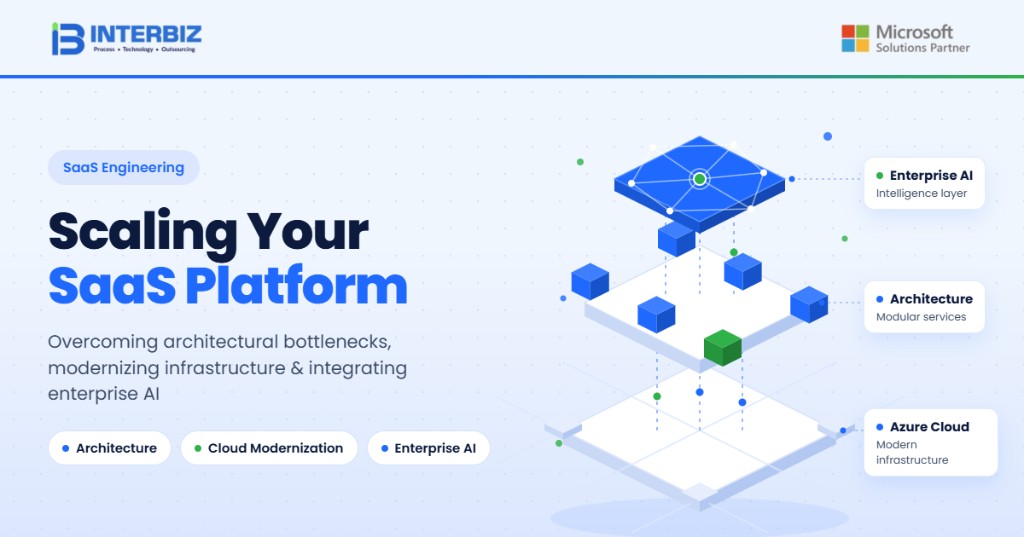
Overcoming architectural bottlenecks, modernizing infrastructure, and integrating enterprise AI—without scaling technical debt faster than revenue.
Product traction is the goal every SaaS leadership team celebrates. But growth exposes what early architecture decisions buried: database contention, runaway cloud bills, brittle integrations, and release cycles that cannot keep pace with enterprise buyers.
Scaling a SaaS platform is not about adding servers before you understand the system. It is a sequence of deliberate moves—from stabilizing data and services, to modernizing on Azure, to layering intelligence responsibly when the foundation can support it.
TL;DR
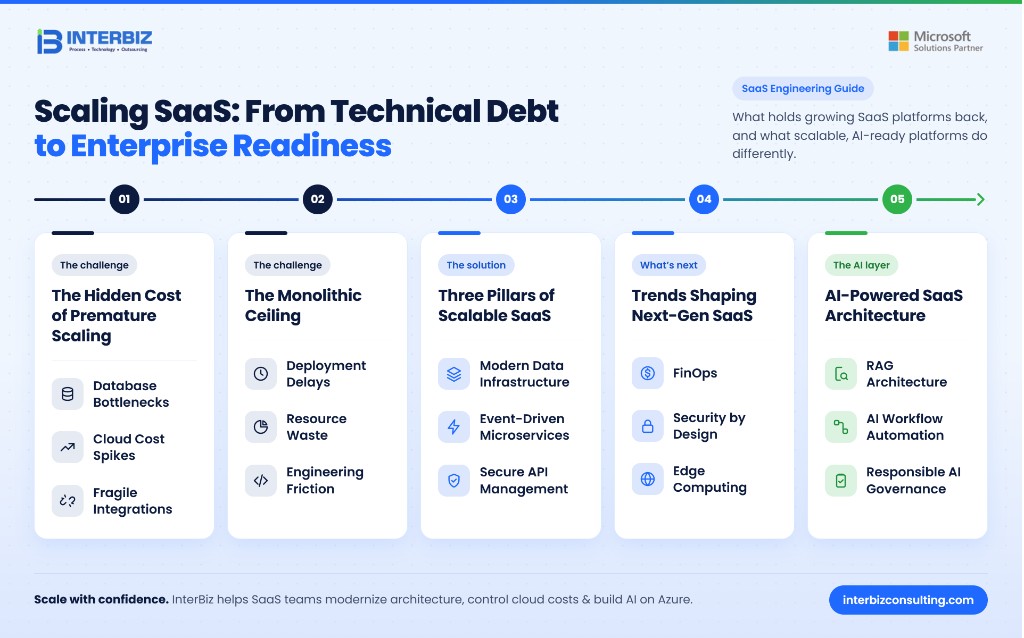
- Premature scaling tax: Throwing capacity at database bottlenecks, uncontrolled cloud spend, and fragile integrations multiplies cost without improving customer outcomes.
- The monolithic ceiling: Tightly coupled codebases slow deployments, waste engineering capacity, and block tenant-specific configuration at scale.
- Three pillars: Modern data infrastructure, event-driven microservices, and secure API management form the core of a platform that can grow with your market.
- Next horizon: FinOps, security-by-design, and edge patterns prepare you for enterprise buyers; enterprise AI (RAG, workflow automation, governance) belongs on top—not underneath.
1. The Hidden Cost of Premature Scaling
When ARR accelerates, teams often respond by provisioning more infrastructure before architecture catches up. That creates a hidden tax on growth:
- Database bottlenecks: Shared schemas, missing indexes, and synchronous writes become customer-visible latency long before sales notices pipeline pressure.
- Cloud cost spikes: Over-provisioned VMs, idle environments, and ungoverned sandboxes turn margin into infrastructure line items with no owner.
- Fragile integrations: Point-to-point connectors and one-off scripts break under new tenants, regions, or compliance requirements.
The fix is not slower growth—it is visibility. Instrument workloads, tie spend to features and tenants, and prioritize the constraints that limit reliability before you scale headcount or clusters.
2. The Monolithic Ceiling
A single deployable codebase feels efficient in year one. By year three it becomes the ceiling on everything else:
- Deployment delays: Every release risks the entire product; hotfixes queue behind full regression cycles.
- Resource waste: Teams scale the whole application for one hot module, paying for capacity everywhere.
- Engineering friction: Onboarding slows, merge conflicts rise, and experimentation gives way to maintenance.
Breaking the ceiling does not require a big-bang rewrite. Incremental extraction of bounded contexts—backed by APIs, automated tests, and clear ownership—restores delivery speed while customers keep running on the platform they trust.
3. Three Pillars of Scalable SaaS
Platforms that scale with enterprise demand share three architectural commitments:
- Modern data infrastructure: Governed lakes or warehouses, reliable pipelines, and tenant-aware models so analytics and AI draw from the same truth.
- Event-driven microservices: Loose coupling through well-defined events and contracts so teams ship independently without breaking neighbors.
- Secure API management: Centralized authentication, throttling, versioning, and observability for partners, mobile clients, and internal tools alike.
On Microsoft Azure, these pillars map naturally to managed data services, Kubernetes or container apps, API Management, and identity integration—reducing undifferentiated ops so engineering stays on product differentiation.
4. Trends Shaping Next-Gen SaaS
- FinOps: Engineering and finance share unit economics—cost per tenant, per feature, per transaction—so scale improves margin instead of eroding it.
- Security by design: Zero-trust patterns, secrets management, and continuous compliance are product requirements, not late-stage checklists.
- Edge computing: Latency-sensitive workflows and regional data residency push compute closer to users without forking your core platform.
5. The AI Layer: Intelligence on a Stable Foundation
Enterprise buyers now expect AI-assisted workflows—but bolt-on copilots on messy data amplify risk. Production-ready SaaS AI typically includes:
- RAG architecture: Retrieval grounded in your governed knowledge and tenant boundaries, not generic public models alone.
- AI workflow automation: Human-in-the-loop steps for classification, drafting, and routing inside existing product flows.
- Responsible AI governance: Logging, policy enforcement, and review paths so security and legal teams can stand behind what ships.
Frequently Asked Questions (FAQ)
When should a SaaS company invest in microservices?
A: When deployment frequency, team size, or tenant-specific configuration makes monolithic releases the bottleneck—not on day one. Start with clear module boundaries and APIs; extract services when the cost of coupling exceeds the cost of separation.
How do we control Azure spend while scaling?
A: Tag resources by environment and feature, right-size continuously, use autoscaling and reserved capacity where workloads are predictable, and assign FinOps ownership so engineering sees cost alongside reliability metrics.
Where does enterprise AI fit in a scaling roadmap?
A: After data governance, integration patterns, and observability are in place. Pilots on unstructured documents or support queues are sensible first steps; platform-wide AI belongs on modular services with explicit governance.
Scale With Confidence
InterBiz helps SaaS teams modernize architecture, control cloud costs, and build AI on Azure—with the same engineering discipline we apply to multi-tenant products in healthcare, fintech, and beyond.
Explore our SaaS platform services or talk to our team about your roadmap.